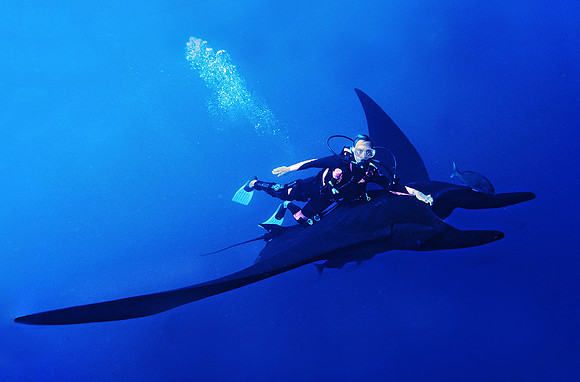
Giant Manta, with diver, near San Benedicto Island
span class="large"stronguA note about diving with, touching, and “riding” Mantas at San Benedicto/u/strong. The photographer is acutely aware of the sensitivity of approaching, interfering with, touching, or harassing wildlife, both underwater and above water, and he strongly supports the general rule that these activities should be assiduously avoided. At The Boiler, however, an interesting phenomenon has evolved. stronguFirst/u/strong, the Mantas there are absolutely huge. The photographer has seen hundreds of Mantas, in locations all over the world; and, based on that experience, the Mantas off San Benedicto are the largest by far. We have seen and dived with Mantas as large as 20 feet in wingspan, that weigh as much as 2,000 pounds! This is not the guess of an adrenaline-pumped photographer; it is the consensus of all divers on board, after diving with these animals for many days and making a concerted effort to estimate accurately their size. stronguSecond/u/strong, although Mantas the world over are generally wary of humans, and rarely permit close approach, the giants off of San Benedicto have become accustomed to the presence of divers and are not afraid of interacting with them. At the risk of sounding like an apologist, these animals are not only accustomed to interacting with divers; they affirmatively seem to enjoy doing so. This is evidenced by several behavior patterns that emerge from repeated close encounters with these wonderful animals: (i) These Mantas will actually approach a diver, if the diver remains stationary. (ii) If a diver swims slowly toward an approaching Manta, the Mantas will often slow down, even to a complete stop, and allow the diver to stroke their underside. (iii) These animals not only seem not to mind this interchange, their “body language” appears clearly to indicate that they enjoy the gentile touching. When a diver strokes the underside of a Manta, the skin “quivers,” in seeming enjoyment, much the way a cat’s skin will do when it is stroked. (iv) More than that, a diver can slowly approach one of these large Mantas from the top, swim with it, and stroke its back. Again, the Manta will often quiver, when petted, in a way that indicates it does not mind, and even enjoys, the sensation. (v) If, based on swimming with and stroking a Manta, it becomes clear that the Manta is unafraid and even enjoys the experience, a diver may often gently clasp the top ridge of the animal’s mouth and be taken, by the Manta, for a slow-speed “ride.” (vi) It is clear from the size and power of these magnificent animals that, if one did not want a diver holding gently onto its back, it could and would take one powerful stroke with its huge wings, and the diver would be left behind. Yet, these Mantas seldom do this, and, for the most part, they actually slow down noticeably when a diver rides with them. It is notable that the dive operators that visit these islands are well-aware of the important need not to harass marine wildlife; yet, based on their extensive experience and the considerations noted above, they encourage divers to interact with these gentle giants, in a careful, slow, and sensitive manner. And, make no mistake, having an encounter with a very large wild animal, in the manner described above, is an emotional peak experience that would be difficult to match anywhere on the planet. If any reader remains unconvinced by the photographer’s experiences and reasoning, please let him have your views on the subject./span